Written by Dr. Shilpa Reddy T, MBBS, DNB Pediatrics, IDPCCM — Consultant Paediatrician & Paediatric Critical Care Specialist, Tiny Totz Kids Clinic, Puppalaguda, Hyderabad
If you've just brought your newborn home and noticed their skin looking slightly yellow — or if a relative has pointed it out and you're now worried — this blog is for you.
Around 60% of full-term newborns and up to 80% of premature babies develop some degree of jaundice in the first few days. For most, it is a normal physiological process. For some, it needs monitoring. For a smaller group, it needs active treatment. Understanding which category your baby falls into is exactly what the first paediatrician visit after hospital discharge is designed to assess.
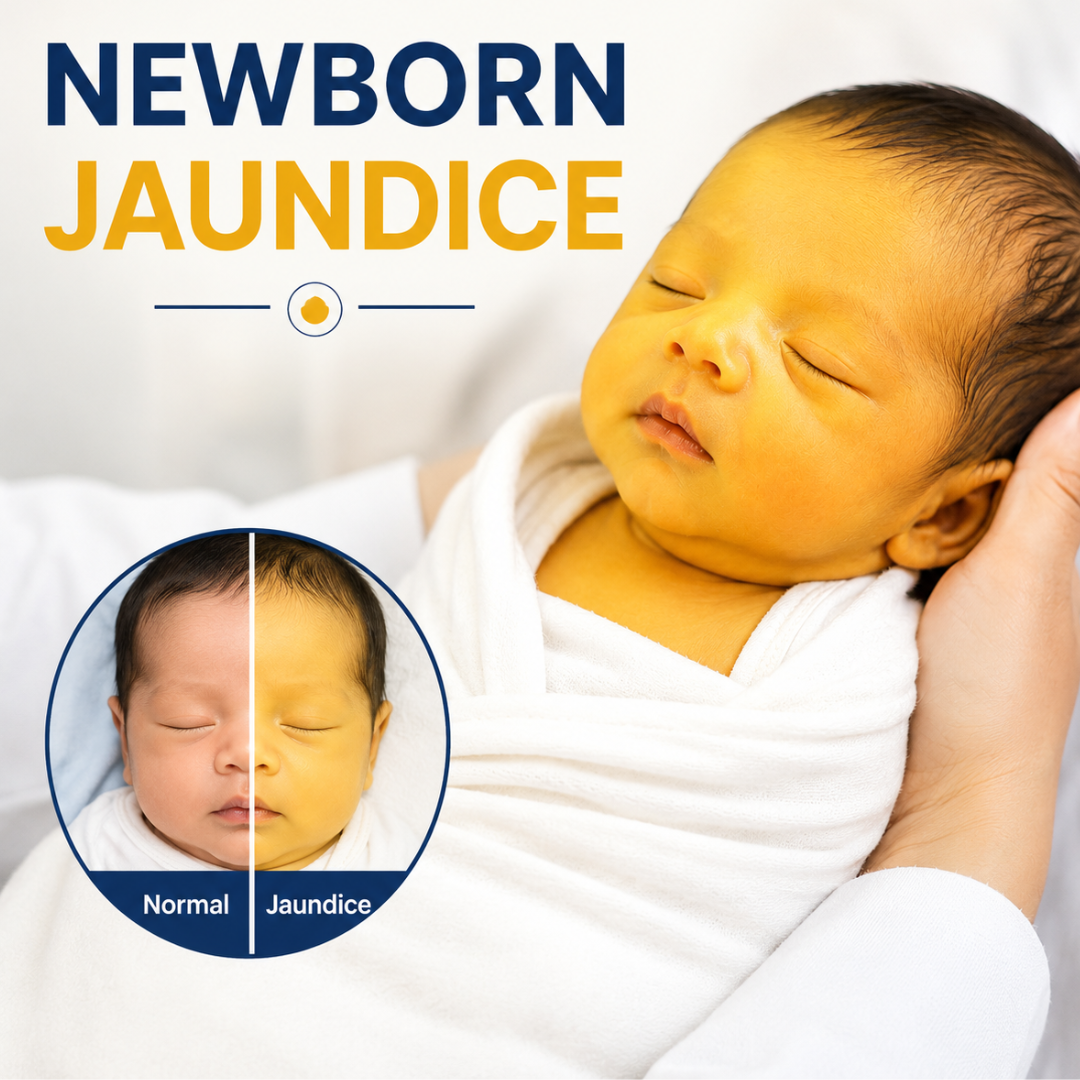
Jaundice is yellowing of the skin and whites of the eyes caused by elevated bilirubin in the blood. Bilirubin is a yellow substance produced when red blood cells break down. The liver processes and excretes it through stool and urine.
Newborns develop jaundice for two reasons: they have more red blood cells that break down faster, and the newborn liver is not yet mature enough to process bilirubin as efficiently. Bilirubin accumulates faster than the liver can clear it.
Physiological jaundice is normal and expected:
At very high levels, bilirubin can cross into the brain, causing kernicterus — permanent brain damage resulting in cerebral palsy, hearing loss, and intellectual disability. Kernicterus is entirely preventable with timely monitoring and treatment. This is why newborn jaundice is taken seriously and why the first paediatrician visit after discharge typically happens within 24 to 48 hours.
Clinical assessment includes the distribution of yellowing, feeding behaviour, and urine and stool colour. Where the level looks significant, a Total Serum Bilirubin (TSB) blood test gives the exact level. Some clinics use a transcutaneous bilirubinometer — a skin device that estimates bilirubin without a blood test, confirmed with a blood test when levels are borderline.
Adequate feeding — always first
Increasing feeding frequency drives more bowel movements, which carry bilirubin out of the body. Breastfeeding should not be stopped for jaundice — it should be continued and, if needed, supplemented. A well-fed baby is a baby excreting bilirubin.
Phototherapy
When bilirubin reaches a threshold based on the baby's age in hours and gestational age, phototherapy begins. The baby is placed under blue-spectrum LED lights that convert bilirubin into a water-soluble form the body can excrete. Phototherapy is safe, painless, and effective. Eyes are covered with shields. Bilirubin typically drops within 24 to 48 hours.
Common misconception: window sunlight is not effective phototherapy. It does not provide the correct wavelength or intensity. Clinical phototherapy under controlled lights is the appropriate treatment.
Exchange transfusion — for very high bilirubin
In rare cases where bilirubin is very high and not responding to phototherapy, a small portion of the baby's blood is replaced with donor blood. A hospital procedure required only in severe cases.
I recommend all newborns be seen within 48 hours of hospital discharge for a jaundice check, weight check, and feeding assessment. If you notice yellow colouring in your baby's skin or eyes at any point in the first two weeks, call or WhatsApp +91 7815933120 for a same-day or next-morning review. Evening OPD: Monday to Friday, 6:00 PM to 9:00 PM, Puppalaguda, Hyderabad.
1. Is breastfeeding making my baby's jaundice worse?
A: Not exactly. Breastfeeding-associated jaundice exists but in almost all cases breastfeeding should continue — stopping is almost never necessary. Discuss with your paediatrician — the answer depends on the bilirubin level and trend.
2. Is sunlight through a window effective treatment?
A: No. Window sunlight does not provide the correct light wavelength or intensity. Clinical phototherapy under controlled blue-spectrum lights is the appropriate treatment. Placing a newborn in direct outdoor sunlight risks sunburn, overheating, and eye exposure.
3. My baby's jaundice level was 14 at discharge. Is that dangerous?
A: Bilirubin levels are interpreted against the baby's exact age in hours and gestational age. Your paediatrician will plot this on a nomogram to determine whether phototherapy is needed — the same number means different things at different ages.
4. The whites of my baby's eyes are still yellow but the skin looks normal. Should I worry?
A: Yellow whites of the eyes (scleral icterus) are more sensitive indicator than skin colour. If it persists beyond 2 weeks in a formula-fed baby or 6 weeks breastfed, or is accompanied by pale stools and dark urine — bring for evaluation. This could indicate cholestatic jaundice, a treatable but different condition.